Minor Arcana · Swords · Number 10
Ten of Swords
Facing a painful ending without forcing a positive explanation.
Keywords
Upright
- painful ending
- finality
- aftermath
- exhausted options
- acknowledging damage
Reversed
- unfinished ending
- changing circumstances
- accepting the end
- addressing consequences
Upright
The Ten of Swords describes a situation understood as having reached a painful conclusion. Recognising an ending does not require you to feel relieved or find a lesson in it immediately.
Reversed
Ways to understand the reversed card: Something prevents action Something is easing or being let go
Something prevents action: The difficult situation continues rather than reaching an ending that would allow it to be dealt with as past.
Something is easing or being let go: The particular difficulty has stopped adding to the damage, leaving its effects to be addressed.
Applying this card to your question
- Love
- Upright Let a confirmed relationship ending be painful without requiring yourself to explain it positively or find an immediate lesson.
- Reversed Distinguish a difficulty still causing harm from its effects after that particular difficulty has stopped.
- Career
- Upright Use actual events to identify what has ended in a difficult work situation.
- Reversed Check whether the problem continues or the remaining task is addressing damage already done.
- Money
- Upright Separate a confirmed end to an arrangement from fears about what must follow.
- Reversed Distinguish an ongoing practical difficulty from remaining costs after the source of damage has stopped.
- Growth
- Upright Allow an ending to feel painful without immediately turning it into a lesson.
- Reversed Ask what is still happening and what belongs to the aftermath of something that has stopped.
- Decision
- Upright Base a choice about closure on what has actually ended.
- Reversed Distinguish a continuing painful situation from an aftermath that needs attention on different terms.
Traditional symbolism
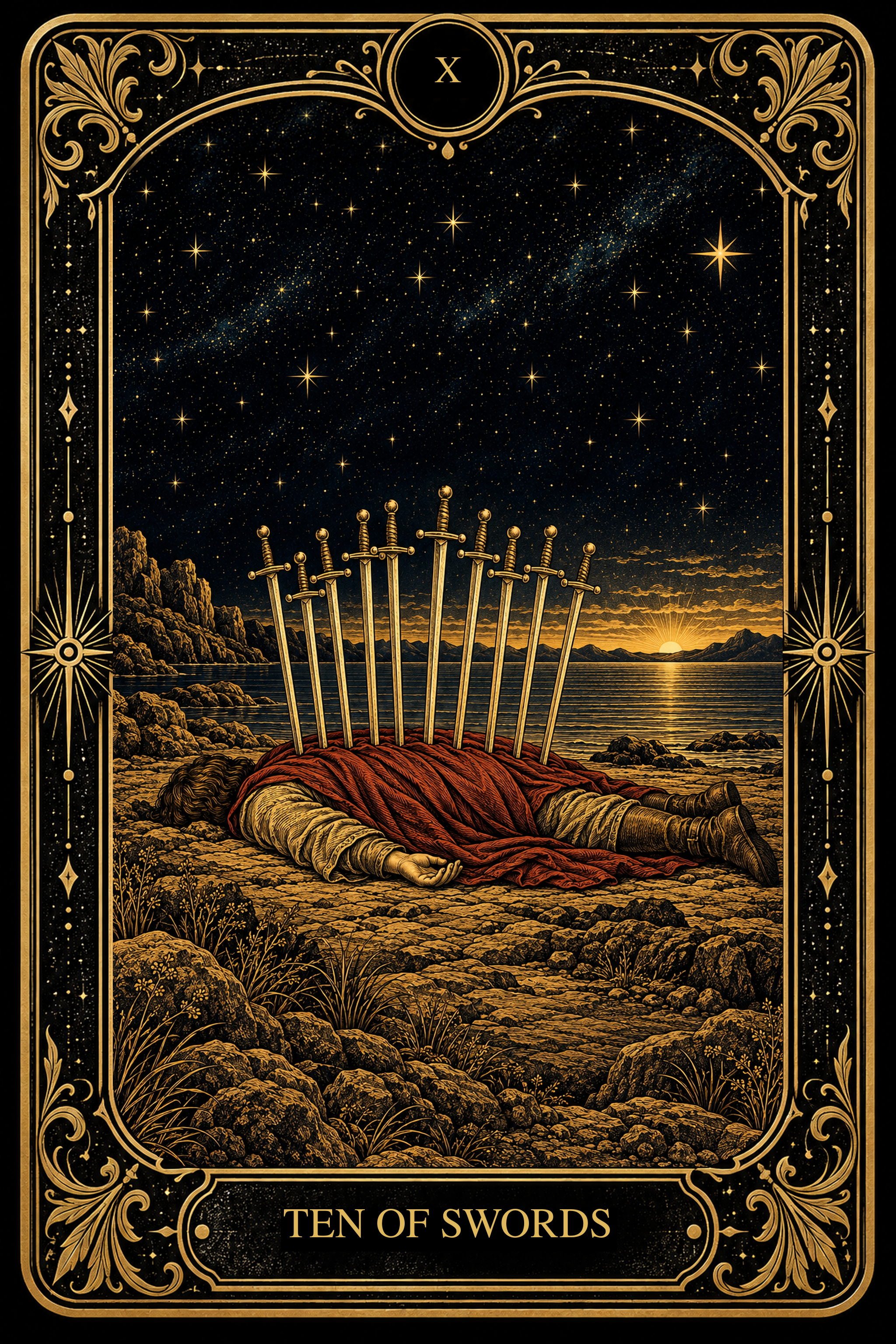
What the Rider-Waite-Smith tradition depicts. This is not a description of any Ultimate Tarot Trainer illustration.
- the prostrate figure
- the end of a damaging experience in the traditional scene
- ten swords, all of them placed
- a situation shown as complete
- black sky lifting at the horizon
- conditions beginning to look different
- still water beyond
- a pause after the difficult experience
Advice
- Upright
- Use the situation's facts to distinguish what actually ended from what remains unresolved. The card alone cannot establish an ending.
- Reversed
- Ask what is still happening and what belongs to what has already happened. Use the facts of the situation to make that distinction.
Learning this card
Common misreadings
- The image does not forecast death, violence or injury. It does not promise that things can only improve. If you are overwhelmed, support matters more than continuing the reading.
- The card does not forecast death, injury or safety, and it does not promise improvement. If you are overwhelmed, support matters more than continuing the reading.
- Use the facts of the situation to choose an interpretation. The card alone does not establish what is happening.
Memory hook
Facing a painful ending without forcing a positive explanation.
Practice
Describe a situation where this guidance fits: Consider what has actually ended and what you are still trying to explain or argue with. Use what you know about the situation, rather than the card alone, to make that distinction.
Historical sources and editorial notes
Lineage: golden-dawn-rws · attribution confidence: traditional
The Sun in the third decan of Gemini follows the Golden Dawn attribution; Book T titles the card Ruin. Waite's published meanings, checked against the Pictorial Key, give pain, affliction, tears, sadness and desolation, together with his explicit note that the card is not especially one of violent death. UTT keeps the finality undiminished and carries Waite's qualification forward, because it is the most useful verified fact available for the card students fear most. This is one of the six records the style guide designates high-difficulty.